Payment availability, bonus eligibility and withdrawal routes can differ, so the cashier and terms need checking together.

A casino can mention a payment method and advertise a welcome offer without making the two compatible. Before you claim a bonus, read the promotion’s terms alongside the rules for the slots you plan to play. The key detail is whether the offer applies to your chosen payment route and whether the games you want are eligible. A headline is not the full deal.
Start with the bonus conditions, not the banner. Look for wording about eligible deposits and excluded payment methods. If Litecoin is listed as a possible way to fund an account, that alone does not confirm that a deposit made with it qualifies for a promotion. The offer may set its own conditions. If the terms do not clearly explain how Litecoin deposits are treated, ask customer support for a written answer before opting in.
Pay attention to when the bonus begins. Some offers require you to opt in, while others may attach automatically under stated conditions. Check whether the terms say you must claim the promotion before depositing, and whether an existing offer prevents you from taking another. These details can affect whether a deposit is matched at all; guessing from the welcome page is a poor substitute for reading the rules.
If you’re looking for a UK casino that accepts Litecoin, check that payment option is currently available to you before signing up. The stated payout speed can also help you assess the withdrawal terms.
WinBeast
WinBeast has a stated payout speed of 1–3 business days. Check whether Litecoin deposits are available to you.
SpinFormula
SpinFormula has a stated payout speed of 1–3 business days. Check whether Litecoin deposits are available to you.
NightWin
NightWin has a stated payout speed of 1–3 business days. Check whether Litecoin deposits are available to you.
EvoSpin
EvoSpin has a stated payout speed of 1–3 business days. Check whether Litecoin deposits are available to you.
SlotoSport
SlotoSport has a stated payout speed of 1–3 business days. Check whether Litecoin deposits are available to you.
Jetsetspins
Jetsetspins has a stated payout speed of 1–3 business days. Check whether Litecoin deposits are available to you.
NightLuck
NightLuck has a stated payout speed of 1–3 business days. Check whether Litecoin deposits are available to you.
x3bet
x3bet has a stated payout speed of 1–3 business days. Check whether Litecoin deposits are available to you.
Zombillion
Zombillion has a stated payout speed of 1–3 business days. Check whether Litecoin deposits are available to you.
BeOnBet
BeOnBet has a stated payout speed of 1–3 business days. Check whether Litecoin deposits are available to you.
Then check which slots count. Promotions may distinguish between eligible and excluded games, or apply different contribution rules to different types of play. Find the section that names eligible games or explains how each game contributes towards any bonus conditions. If a particular slot is not listed, do not assume it counts just because it appears in the casino lobby. Ask support if the wording leaves room for doubt.
Keep the promotion’s requirements separate from the game’s own features. A slot may be available to play while still being excluded from a bonus, or it may count differently under the promotion’s rules. Check for restrictions on features such as bonus rounds or other special play modes, if the terms mention them. The practical question is not simply “Can I open this game?” but “Will playing it keep me within the offer’s conditions?”
A useful way to read the small print is to trace the offer from start to finish: what qualifies you, which games count, what actions can void the promotion, and what happens once its conditions are met. Look for any stated time limit, maximum bonus, withdrawal cap or other restriction, but rely on the current terms for the actual details. Those details can differ between offers, so one promotion’s rules are not a guide to another’s.
Payment-related exclusions deserve their own check. A specialist review has reported that PayPal may be excluded from bonus eligibility, while a separate specialist review has described Skrill and Neteller as methods that can be excluded from promotions. Treat these as prompts to inspect the live terms, not as rules that apply to every casino. If you intend to use Litecoin, look specifically for the method in the offer’s exclusions or eligibility wording rather than assuming that rules for a different payment service carry over.
If you are comparing a Litecoin deposit with a bonus, compare like with like. Check whether the promotion is available to new or existing customers, whether it requires an opt-in, and whether the payment method is eligible. Then confirm that the slot you intend to play is covered. A bonus can look generous while being irrelevant to your preferred game or payment route. Dry, but useful.
Keep a copy of the terms as they appear when you claim the offer. Promotions can change, and a clear record helps if the wording later becomes difficult to find. Save the relevant page or take a screenshot, including any linked game restrictions. If support confirms an interpretation, keep that reply too. You are not looking for a promise that every game or deposit qualifies; you are pinning down the conditions that apply to this particular offer.
One final distinction matters: bonus eligibility is not the same as payment availability. A casino may describe a method in one place and set separate promotion rules elsewhere. Read both before making a decision, and do not treat a general statement about bonuses as confirmation that a Litecoin-funded deposit will qualify. If the terms are silent or contradictory, pause and ask the operator to clarify the promotion in writing.
A payment logo on a casino’s homepage is a clue, not confirmation. I treat it as an invitation to check the cashier, where the options shown should relate to the account I’m actually using. A method can appear on a general payments page yet be unavailable for a particular account, country setting or transaction. That distinction matters if you are looking for a casino where you can deposit Litecoin: a mention elsewhere on the site does not, by itself, confirm that you can select it.
Start by signing in and opening the cashier, rather than relying on a promotional banner or an old review. Check the available methods in the deposit area and read the labels carefully. The list may include cards, bank transfer, e-wallets or cryptocurrencies; a specialist review of casino payment pages, for instance, may describe several of these categories. But a review is not your live account screen. Treat it as a starting point, not proof of availability.
If Litecoin is not visible, do not assume that Bitcoin or a general “crypto” label means Litecoin is supported. Payment methods are not interchangeable just because they sit in the same broad category. Look for the exact currency or asset name. Equally, if a site mentions Litecoin on a public page, check whether it appears as an available choice in your own cashier before planning around it.
The same check applies to familiar methods. A specialist review may list Visa and Mastercard, but that does not settle whether either is currently offered to you in the UK or whether your particular card product is eligible. The cashier is where you can see what the site presents for your account. If a method is absent, or the screen gives a restriction, pause and ask customer support rather than trying to work around it.
A careful check is simple:
That is a compatibility check, not a reason to send money just to see what happens. Stop before confirming a transaction if the currency, account details or payment route do not match what you expected. If support gives you an answer, keep it with the relevant terms or a screenshot of the cashier; it is much easier to resolve a mismatch while the transaction is still only a plan.
Pay attention to which version of the site you are viewing. A payment page open while signed out may show general information, while the logged-in cashier is tied to your account. If you are using a casino app, check the cashier there too; do not assume that a list shown on a desktop page proves what is available in the app, or vice versa. If the two screens differ, ask which one reflects the current options for your account.
Also check the account information before you proceed. The account holder and the payment route should belong to the same customer; mismatched ownership details can create avoidable friction. If the cashier indicates that an account detail needs attention, deal with it first rather than treating the payment choice as confirmed. For a UK-facing casino, check that the operator holds a current UK Gambling Commission licence on the public register before depositing. A polished cashier is not a substitute for that check.
There is no need to guess from the wording on an advert. “Crypto accepted” may be too broad to answer whether Litecoin is available, and a list of payment brands may not reflect the live choices offered to you. Ask a direct question: is this exact method available to my account, in my location, for the transaction I intend to make? If the answer is conditional, find out what condition applies before you continue.
Keep the check narrow. You are establishing whether the cashier offers a payment route to your account, not whether a site’s general marketing language sounds promising. When the live screen and the written answer agree, you have a clearer basis for deciding whether to continue. When they do not, hold off. A logo is not a payment option.
I can’t confirm which UK online casinos currently accept Litecoin. That is not the same as saying none do: it means you should not treat a general claim about crypto payments as proof that Litecoin is available at a particular casino.
The distinction matters because “cryptocurrency accepted” is not a specific payment promise. A cashier might support one digital currency but not another, or a payment page might describe a method that is not offered to every customer. Litecoin needs to appear by name in the live payment options for the account you intend to use. A logo, an old review or a broad statement about crypto does not settle it.
Before relying on a Litecoin option, sign in and check the casino’s own cashier. If the method is not displayed there, ask customer support whether Litecoin is available to UK customers on your account. Keep the answer specific: ask about Litecoin, not just cryptocurrency, and clarify whether the option is enabled for your account. A clear answer is more useful than a page that leaves the payment route ambiguous.
Also separate a casino’s general claims from the rules that apply to you. The payment screen and the operator’s terms should agree on the method offered. If they do not, pause and get clarification rather than sending funds on the assumption that the cashier will accept them. Payment support can be conditional, and an option mentioned elsewhere may not be available when you reach the transaction stage.
For a UK player, the operator’s regulatory status matters independently of its payment menu. A Litecoin label does not tell you whether a site is authorised to serve customers in Great Britain. Remote gambling licensees offering real-money play to customers there must hold the relevant UK Gambling Commission licence. Check the operator on the Commission’s public register before depositing; an offshore site does not become a UK-licensed casino by displaying a familiar payment symbol.
That leaves a practical answer to “Can I use Litecoin at an online casino in the UK?” Possibly, but do not assume it from a search result or a general crypto claim. Confirm that the specific casino names Litecoin in its live cashier, that the option is available to your account, and that the operator is properly licensed for the British market. If any of those points is unclear, do not treat Litecoin as a confirmed route.
A short check saves a longer mess.
A casino accepting Visa or Mastercard does not, by itself, mean it accepts Litecoin. Those are different payment routes: a debit card payment is processed as a card transaction, while a Litecoin payment involves a cryptocurrency transfer. Seeing familiar card logos tells you nothing conclusive about whether the casino’s cashier supports Litecoin.
Debit cards are commonly accepted at UK casinos, including Visa and Mastercard. But a logo on a general payment page is not a promise that every card will work for every customer. A specialist review may list those brands, yet current UK availability and eligibility still depend on the casino’s cashier and the particular card product. Check the details that apply to your own account rather than treating a broad list as confirmation.
The same distinction matters if you have a card connected to a cryptocurrency account. A card that lets you spend funds held with a crypto service is not automatically a Litecoin payment method at the casino. The casino may see and process a card transaction; that does not establish that it accepts Litecoin directly, or that the card can be used there. The payment route is what matters, not the label attached to the balance behind it.
Nor does a card’s ability to hold or convert crypto make it a “Litecoin debit card” in the casino cashier. Check what the product actually is and how the transaction is funded. A debit card linked to your bank account and a card connected to a crypto service may have different eligibility, even when both display the same card-network logo. Don’t assume one will behave like the other.
There is another important UK distinction: credit-card payments for gambling are banned at UK-licensed casinos. That restriction has not been relaxed. A credit card does not become an acceptable gambling payment just because it is routed through another service, and a card with a crypto connection does not override the rule. Check that the card is an eligible debit product, not simply that it carries a familiar brand.
I’d separate the questions rather than bundle them together: does the casino accept card deposits, is your specific card eligible, and does the cashier explicitly offer Litecoin as its own method? A “yes” to one does not answer the others. It is easy to mistake a card logo for proof of crypto support. It isn’t.
This also applies when browsing on a phone. A mobile site may show the same card options as its desktop version, but that still does not tell you whether Litecoin is supported or whether your card product qualifies. The payment method needs to be identified as Litecoin in its own right; a card transaction should be judged as a card transaction.
Keep the terms precise when comparing options: “debit card accepted” is a claim about a card route, while “Litecoin accepted” is a claim about cryptocurrency support. Neither phrase should be used as shorthand for the other.
A casino taking a payment method and a casino offering slots you can play are separate things. Before treating a site as a suitable place to play with Litecoin, check that its slot catalogue is available to your account and that the games you want are accessible on your device. A payment label alone tells you nothing about the games or the conditions attached to them.
I would start with the casino’s own games page, then open a slot and read its information panel. Check whether the game is available to you, whether it has any stated restrictions, and whether the rules explain how a round works. A catalogue can change, and seeing a game mentioned elsewhere is not proof that it is currently available at a particular casino. No reliable shortcut there.
Mobile access deserves its own check. Open the site on the phone or tablet you plan to use and see whether the slot loads and plays properly in that browser. A site being described as mobile-friendly does not confirm that every game works on every device. If you cannot inspect the game before registering, ask support about access rather than assuming that a mobile version or a Litecoin-specific slot range exists.
Pay attention to the way slots operate in Britain. Autoplay is not permitted for online slots, and each spin must last at least two and a half seconds. Those are operating conditions, not optional settings to look for in a game menu. The maximum stake per game cycle is £5 for players aged 25 and over; for players aged 18 to 24, it is £2. Make sure the stake controls and game rules are clear before you play.
The operator matters as much as the game. Remote gambling licensees serving customers in Great Britain need the relevant UK Gambling Commission licence, and online gambling is legal in the UK only through licensed and regulated sites. Check the licence on the Commission’s public register rather than relying on a payment symbol or a page describing a casino as new. You must be at least 18, and the operator has to verify your age before letting you deposit.
I also check the account controls before settling in. UK-licensed casinos must give customers access to tools such as self-exclusion, and new customers must be asked to set a financial limit before making their first deposit. Make sure you can find those controls in the account area; they should not be buried behind a support conversation.
None of these checks establishes that a particular game can be funded or played using Litecoin. Keep the two questions separate: first, can you access the slot and understand its rules; second, does the casino support your intended payment route for your account? Treat claims about the best Litecoin slots or a special mobile selection cautiously unless the casino itself confirms what is currently available. A little checking beats guesswork.
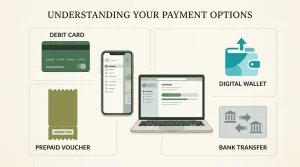
If Litecoin is not offered, you still have several familiar ways to fund a UK casino account. The useful comparison is not simply which button looks quickest. Check what each route lets you do, whether it suits your account, and whether its conditions fit how you plan to play.
Visa and Mastercard are common for those wanting to pay directly from a bank account.
Includes open banking for those preferring direct bank movements over cards or crypto.
Services like Skrill and Neteller, though they are often excluded from promotions.
Prepaid vouchers used for deposits only, not for withdrawals.
Debit cards are a straightforward alternative at many UK casinos. Visa and Mastercard are commonly accepted, though a payment option being familiar does not mean every card or account will be eligible. A card can suit someone who wants to pay directly from a bank account rather than move funds through another service. Treat it as a separate option, not as a Litecoin-linked payment route.
Bank transfers and open banking are another possibility. They can be convenient if you prefer to move money from your bank rather than use a card or cryptocurrency. A specialist review has described these services as supporting instant deposits and fast withdrawals at many sites; that is not a promise for every casino or transaction. The available route and its timing depend on the particular service and site.
E-wallets offer a different way to separate casino payments from card payments. Skrill and Neteller are available at some sites, but a specialist review notes that they are often excluded from promotions. If a bonus matters to you, check its payment conditions before choosing an e-wallet. An accepted deposit method and a promotion-eligible method are not necessarily the same thing.
Paysafecard works differently again: it is a prepaid voucher for deposits only. That can make it an option if you want to use a voucher rather than a bank-linked payment route, but it is not a complete deposit-and-withdrawal option. Keep that distinction in mind when comparing it with cards, bank transfers or e-wallets.
There is no single best Litecoin alternative for every player. A debit card may be familiar; a bank transfer may suit your banking habits; an e-wallet may be useful if you already use one; and a prepaid voucher has a narrower role. Availability varies by casino, so compare the actual options offered rather than assuming that a method accepted elsewhere will work on your chosen site.
I’d also compare the terms attached to the route, not just its name. A payment option can be available while still being unsuitable for a particular bonus or account. That small distinction saves a nuisance later.
Treat a Litecoin logo or a sentence on a review page as a lead, not confirmation. Payment menus can change, and a method described in an older specialist review may not be available to a UK customer now. Sign in to the casino’s live cashier and inspect the methods shown for your account. If Litecoin is not there, do not assume that a general “crypto accepted” claim includes it.
Check the wording carefully. A site may mention cryptocurrencies without naming Litecoin, or a payment service may support digital assets on its own platform without being available as a casino cashier option. You need to see Litecoin identified as a method the casino itself accepts. A vague reference to “crypto” is not enough to confirm it.
Next, check the account currency before authorising anything. A specialist review may describe GBP as supported, but the currency attached to your own account is what matters. Look for it in the cashier or account settings, and check whether the Litecoin route would convert the balance. A mismatch can mean you do not see the amount credited in the currency you expected.
Then confirm that the method is eligible for your account and intended transaction. A cashier can display a payment option while access still depends on account status, location, or other checks. If the method appears but the site does not explain whether it is enabled for you, ask customer support to confirm before proceeding. Keep the response and the cashier details together; that gives you something concrete to refer to if the answer differs later.
Checking Litecoin Support
Inspect the Cashier
Sign in and look for Litecoin specifically named in the live payment options.
Verify Account Currency
Check if the balance is in GBP and how the Litecoin route handles conversion.
Contact Support
Ask for confirmation that the method is enabled for your specific account and location.
Cross-Reference Licence
Verify the operator on the UK Gambling Commission public register.
Do not confuse a payment label with a guarantee that a transaction will work. A failed attempt may leave you uncertain about whether the issue was the casino, your account, or the payment service. Checking availability first is less exciting, but it avoids turning a small test into a support conversation.
For a UK player, the practical test is simple: Litecoin must be named in the live cashier, the option must be available to your account, and the account currency must be clear before you act. If any part is missing, pause and get a direct answer rather than relying on a claim that a casino takes Litecoin. “Instant” in a page heading or promotional description is not proof of live availability or a promise about processing.
You can also check that the site is operating under a current UK Gambling Commission licence before opening an account. That is a separate question from payment support: a Litecoin option does not establish the operator’s regulatory status, and a licence does not establish that Litecoin is accepted. Verify both independently.
A Litecoin deposit does not, by itself, tell you how a casino will pay out. Before you play, read the withdrawal terms for the route attached to your account: a casino may return funds to the original payment source under UK anti-money-laundering rules. This is part of its checks, not a promise that you can choose any destination later.
That matters if you are looking for a Litecoin withdrawal or a casino that pays directly to Litecoin. Check the operator’s own cashier and terms for whether that route is available for withdrawals, and whether it applies to your account. A mention of Litecoin on a general payments page is not confirmation that a Litecoin payout is supported. Nor does a card described as Litecoin-linked automatically establish that the casino will send winnings to it.
Closed-loop rules can also mean a different route needs extra checks. Keep the payment account and casino account in your own name, and use consistent details. It is a simple way to avoid preventable ownership questions. If the stated payout method does not suit you, ask support before depositing rather than finding out after a withdrawal request.
The time shown for a payout may not start when you click “withdraw”. The casino first has to review and approve the request; the payment provider’s processing comes after that. A specialist review notes that first withdrawals can take longer while verification is completed. Treat that as a reason to check your own account status, not as a guaranteed timetable for every casino.
Have your KYC documents ready and respond promptly if the casino asks for evidence. Incomplete verification can hold up approval, and a request for additional checks may add another step. Once the casino releases a payout, its own processing time and the payment route still affect when the money reaches you. “Pending” and “sent” are not the same status.
For a UK player, the safer comparison is not simply which Litecoin casino promises the fastest withdrawal. Check that the operator holds a current UK Gambling Commission licence, then confirm the payout route, verification requirements and how the site describes each processing stage. If a site advertises a Litecoin card or instant payout, look for the exact withdrawal conditions behind that wording. Fast claims are easy. The route back is the useful detail.
Before you fund an account, check the minimum for the payment route you intend to use. A specialist review puts the starting deposit range at £10–£20, with the precise threshold depending on the method. Treat that as a guide, not a promise: the amount shown for your account in the live cashier is the one to budget around. Deposit ceilings can also differ by payment method and account status, and may be set per transaction or across a day or month.
If you are considering Litecoin, work out the cost of the whole transaction rather than looking only for a casino fee. A specialist review identifies several possible charges: the casino’s own fee, the payment provider’s charge, bank or issuer costs, the exchange-rate spread and, where relevant, a network fee. Which ones apply depends on the route and amount. A conversion spread can be easy to miss because it is reflected in the rate rather than shown as a separate charge.
There is no single payment method that is cheapest in every case. Compare the total you would spend for the amount you actually plan to deposit, including any conversion from pounds to another currency and any Litecoin network cost. A specialist review makes the same point: the apparent absence of a flat fee does not tell you what the exchange rate or network charge will cost.
Check the account currency before making that comparison. If your balance is held in a currency other than pounds, conversion may affect both what leaves your payment account and what appears in the casino balance. Don’t rely on a displayed headline amount alone; read the final transaction summary before confirming.
Budget controls matter too. UK rules require remote gambling licensees to ask new customers to set a financial limit before their first deposit and make account-level limit controls accessible. Set a limit that fits your own budget, then treat it as a boundary—not as a target to spend.
A casino’s use of Litecoin does not tell you whether it is connected to GamStop, what licence it holds or which safer-gambling controls it provides. These are separate questions. A claim such as “Litecoin casinos not on GamStop” is not a reliable way to assess the site.
For customers in Great Britain, remote gambling licensees serving the market must hold a UK Gambling Commission licence. Check the operator’s licence on the Commission’s public register before opening an account, and read the operator’s own information about self-exclusion. Do not treat a payment method, a promotional label or a search result as proof of either.
There is also a difference between an operator’s own account controls and participation in a particular self-exclusion scheme. If you need to know whether an operator is covered by GamStop, confirm that directly through the scheme and the operator’s terms. Don’t assume that “not on GamStop” means the site is outside UK rules, or that a Litecoin payment changes those rules. The operator matters. The coin doesn’t.
UKGC rules also require remote gambling licensees to prompt new customers to set a financial limit before their first deposit and to make account-level limit controls accessible. Check that these controls are available and understand how they work before you play. If you have self-excluded or are trying to avoid gambling, don’t use an alternative payment method or a different site to get around that decision; consider using the support and blocking tools available to you.
Claims about Litecoin casinos being “unaffected” by GamStop can blur licensing, scheme participation and payment support into one sales pitch. Keep them separate. Verify the licence, establish the operator’s self-exclusion arrangements, then decide whether the site fits your needs. If any of those details are unclear, leave the account unopened.
PayPal, open banking services and debit cards linked to fast payout systems are generally among the quickest. Your payout can still take longer if the casino needs to approve it or verify your account.
Yes, casinos may need to verify your account, particularly before a first withdrawal. Payouts can take longer while those checks are completed, and UK anti-money-laundering rules commonly require funds to go back to the original payment source.
No. UK casinos commonly accept Visa and Mastercard debit cards, but check the cashier and your card’s eligibility; credit cards cannot be used for gambling.
The casino must approve the withdrawal, and verification—especially for a first payout—can add time. The payment provider’s processing can also affect how quickly the funds arrive.
Yes, Skrill is available at some UK-friendly casino sites. Check the cashier for your account, and review the promotion terms because Skrill deposits may be excluded from bonuses.
The minimum deposit usually starts at £10–£20, depending on the payment method.
There is no universally cheapest method. Compare casino and provider charges, bank or issuer fees, currency-conversion spreads and any network costs for the amount you plan to deposit or withdraw.