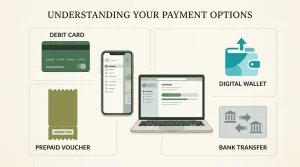
Understand how debit-card deposits work, which card networks may be supported, and why withdrawal routes and casino terms need checking.

A debit card is a familiar way to pay online: you use a card connected to your bank account, and the payment is authorised through the card network and your bank. At UK online casinos, this makes a debit card one of the straightforward payment routes to recognise. Visa and Mastercard are commonly accepted, although that does not mean every casino supports every card or card product.
The basic idea is simple. You choose a card payment in the casino’s cashier, enter or select the relevant card details, and the transaction is passed for authorisation. If approved, the amount is taken from the account linked to the card. It is not a separate casino balance or a borrowing facility; it is a payment made using your own available funds. That distinction is worth keeping clear, even if the cashier makes the process look much like any other online checkout.
I find debit cards appealing mainly because they are already part of everyday banking. There is no need to learn a new payment brand before you understand how the payment works. For many people, the same card they use for ordinary online shopping is the first method they look for when opening a casino cashier. The familiarity helps, but it does not override the casino’s own payment settings or the bank’s decision on a particular transaction.
When choosing a UK casino that accepts debit cards, payment details can help you decide what to check before signing up. Use the stated payout speed as one factor in your choice.
WinBeast
WinBeast has a stated payout speed of 1–3 business days, a detail you can consider when reviewing its payment options.
SpinFormula
SpinFormula has a stated payout speed of 1–3 business days, which you can weigh alongside the payment details that matter to you.
NightWin
NightWin lists a payout speed of 1–3 business days, giving you a specific timing detail to consider.
EvoSpin
EvoSpin lists a payout speed of 1–3 business days, which may help you assess its payment arrangements.
SlotoSport
SlotoSport has a stated payout speed of 1–3 business days, a useful detail for you to check when considering payments.
Jetsetspins
Jetsetspins has a stated payout speed of 1–3 business days, giving you one concrete payment detail to review.
NightLuck
NightLuck lists a payout speed of 1–3 business days, which you can take into account when reviewing its payment options.
x3bet
x3bet has a stated payout speed of 1–3 business days, a timing detail you can consider before choosing.
Zombillion
Zombillion lists a payout speed of 1–3 business days, giving you a specific payment detail to bear in mind.
BeOnBet
BeOnBet has a stated payout speed of 1–3 business days, which you can consider when checking its payment arrangements.
When people talk about debit-card casinos in the UK, Visa and Mastercard are the names that tend to matter first. Both are commonly accepted across UK casinos. That gives you a sensible starting point when looking for an online casino that accepts debit cards, but it is not a promise that your particular card will work everywhere.
A logo on a payment page tells you which network may be supported. Your card also has a specific product and is issued by a particular bank, and those details can affect whether a payment goes through. The casino’s cashier is the practical place to see what it currently offers. A general claim that a site accepts Visa, for instance, is not the same as confirmation that every Visa debit card is eligible.
It helps to think of acceptance as a chain rather than a single yes-or-no label. The casino needs to offer card payments; the card network must be supported; the card itself must be eligible; and the transaction must be authorised. If one link does not line up, the payment may not complete. That is not necessarily a sign that debit cards are unavailable at the casino altogether. It may be specific to the card or transaction.
Seeing debit cards among the available methods tells you something useful about the casino’s payment options. It does not tell you that all other parts of the site will suit you, or that a card is automatically the best way for you to pay. Nor does it mean that the payment experience will be identical from one casino to another. The card networks are familiar; the operator’s cashier is where the details vary.
For that reason, I would treat the phrase “debit-card casino” as a description of a payment route, not a special category of casino. It does not refer to a particular kind of game or account. It simply means that card payments are offered as a way to move money into the account. Whether that option is available to you is a separate, practical question.
You may also see other payment names alongside cards. Their presence does not make them interchangeable with a debit card, and a method that appears in one casino’s cashier may not appear in another. The useful point at this stage is not to assume that every site has the same menu. Card acceptance is common in the UK, but payment menus are set by individual operators.
For someone new to online casino payments, a debit card can feel like the least complicated place to begin because the payment method is already familiar. You know which bank account it is linked to and can recognise the transaction through your usual banking services. That familiarity is helpful, but it is not a guarantee of approval or a reason to skip the casino’s own information.
If you are searching for the best debit-card online casino, it is easy to read “accepts Visa” or “accepts Mastercard” as a complete answer. It is only one part of the picture. The wording confirms a general payment capability; it does not settle the status of your exact card or tell you how the cashier will handle your account. Better to regard the card logo as a useful signpost than a contract.
There is no need to make the subject more mysterious than it is. A debit card is a bank-linked payment method, Visa and Mastercard are commonly accepted by UK casinos, and individual availability can still differ. Once you understand that distinction, the phrase “online casino with debit card” is less of a promise and more of a starting point. The detail sits with the specific cashier.
A debit card being accepted is only the starting point. When you compare casino sites, look at the cost of moving money, the terms attached to the payment route and whether those terms suit how you intend to use your account. A site that looks inexpensive at first glance may involve a cost elsewhere in the transaction.
A payment can involve charges from more than one place. A specialist payment review identifies possible costs such as a casino charge, a payment-provider fee, a fee from your card issuer or bank, an exchange-rate spread, or a network fee. Not every transaction attracts every charge, and a fee-free statement from the casino does not tell you what your bank or other providers might charge.
That makes the full cost more useful than any single headline. Check whether the casino itself charges for the payment, then consider any separate costs that may apply through your own card or payment service. If more than one route is available, compare the likely cost for the same amount rather than treating one method as automatically cheaper.
A visible flat fee is easy to spot. Currency conversion can be less obvious: the exchange-rate spread is the difference built into the rate used for the transaction, and it can outweigh a clearly stated fee. So a payment with no displayed charge is not necessarily the lowest-cost option. The rate matters too.
The cheapest route depends on the transaction being considered. A fixed charge has a different effect from a cost linked to the amount, while a conversion spread changes the value of the exchange. Network costs may also form part of the total. There is no single payment method that can be called the lowest-fee choice in every case.
I would compare the same intended amount across the available routes and add together the costs that apply: the casino’s charge, any provider or bank fee, the currency spread and any network cost. If one route is priced in a different currency, include the conversion in that comparison rather than looking only at the stated fee. It is a more grounded way to judge whether a debit-card casino deposit is good value than relying on a broad claim that payments are free.
The final amount credited to your casino account is the practical point of comparison. A charge can be small in isolation but still matter if it is applied each time you make a transaction. Equally, a rate-based cost may be harder to notice than a flat fee. Read the wording carefully enough to understand which costs are fixed, which depend on the amount and which may be set by another party.
Payment terms are part of the offer. Check what the casino says about charges and whether the explanation distinguishes its own fees from those that may come from a bank, provider or network. If wording is broad, do not assume it means that every part of the transaction is free. It may describe only the casino’s side of the payment.
The same care applies when comparing a debit-card casino site with another payment route. A payment method can appear attractive because one charge is absent, while a different cost still affects the overall value. Comparing like with like keeps the decision practical: consider the same amount, the same currency treatment and all costs that may apply, not just the most prominent line in a payment description.
I also avoid treating a general label such as “low cost” as a calculation. The amount you plan to move and the way the transaction is priced both matter. A flat fee, exchange spread and network cost do not behave identically, so a simple ranking of payment methods can hide what you would actually pay.
There is no universal winner among debit-card casino sites on fees alone. The better fit is the one whose payment terms are clear and whose combined costs make sense for the transaction you have in mind. A site’s own charge is only one part of that picture; your bank, provider, currency conversion and network may also affect the total.
Keep a short comparison of the costs and terms you can establish for each option. That does not need to become a grand spreadsheet. The useful distinction is whether a charge is stated by the casino, may come from another party, or is embedded in the exchange rate. Once those are separated, the real price is less likely to be obscured by a neat “no fee” label.
The amount you can put into a casino account is not set by one UK-wide figure. A minimum applies to each payment method, while the maximum can depend on the method you use and the status of your account. So even if you have a debit card ready, check the limits shown in the cashier before deciding how much to add.
A specialist review reports that minimum deposits can fall in the £10–£20 range, depending on the payment method. Treat that as an indication, not a promise that every casino or every card payment will fit it. The operator’s own cashier is the useful place to confirm the amount currently offered to you. A payment can be declined if it falls below the stated minimum, so there is little point guessing.
The other end of the scale is less tidy. A casino may set a maximum for one transaction, and separate caps for deposits over a day or a month. Those ceilings can differ by payment method and account status. Specialist casino reviews describe this variation, but the terms displayed by the operator are what matter for your account. If you plan a larger deposit, read the relevant limit before submitting it rather than assuming that a limit shown elsewhere applies to you.
The financial limit is not the same thing as the casino’s payment cap. A payment cap says how much the operator will process; a financial limit is a control you choose for your gambling account. It helps you decide in advance what you are comfortable spending, rather than making that call in the moment.
UK rules require a remote gambling operator to invite new customers to set a financial limit before they make their first deposit. The operator must also make account-level limit controls accessible, so you can manage your limit after setting it. Take a moment to use those controls deliberately. If the site lets you set different types of limit, read what each one measures before confirming it; a label can sound clear while the period or activity covered is easy to overlook.
I would treat the limit as a personal boundary, not as a target to spend up to. Decide what fits your budget outside the casino, then choose controls that help you stick to that decision. If you find yourself raising a limit because you have already spent more than intended, pause rather than treating a higher ceiling as a fresh budget. The control is there to support your plan, not to make a loss easier to chase.
Before confirming a deposit, compare the amount you intend to add with both the payment minimum and any maximum shown for that transaction. Then check your account controls. A casino’s transaction cap may allow a payment that is larger than the personal financial limit you chose, or your chosen limit may prevent a deposit that the cashier otherwise permits. They serve different purposes.
Be careful not to read an unavailable amount as a technical glitch straight away. The payment could be outside a stated minimum or maximum, or your account-level control could be stopping it. Check the message on screen and the terms attached to the limit. If the reason remains unclear, ask the operator before trying again; repeated attempts are a poor substitute for knowing which control has stopped the payment.
Your account status can also affect the maximum available to you. That means a figure someone else mentions, or one shown in a general review, may not be the figure presented in your own account. Use the live cashier and account settings as your reference, and revisit them if the operator changes the terms or your circumstances change.
A debit-card deposit is still money leaving your bank account. Before you approve it, make sure the amount fits the budget you set and that you understand the limit controls already in place. If the minimum is more than you intended to spend, do not raise your budget just to make the transaction fit. There will be another time to play; the bank balance is less patient.
Once a limit is set, check that it remains visible and that you know how to manage it from your account. I find that a clear boundary is more useful than making a new spending decision each time I reach the cashier. The aim is not to deposit the maximum the site permits. It is to make a deliberate choice, within your own means, and leave the controls working in your favour.
The important distinction is between paying from a debit card and making a credit-card payment for gambling. A UK-licensed casino may accept an eligible debit-card payment, but it cannot accept a credit-card payment for gambling. The fact that both cards carry a familiar payment-network logo does not make them interchangeable under the rules.
The ban on credit-card gambling took effect on 14 April 2020 and remains in place. It applies to remote gambling operators serving the British market, which must hold the relevant UK Gambling Commission licence. It also covers credit-card funds routed through a money service business: adding an intermediary does not turn a prohibited payment into an acceptable one. Nor can an operator accept a wallet payment where that wallet allows credit-card funds to be used for gambling.
That leaves debit cards as a distinct payment option, not an exception that lets credit borrowing slip through another door. A debit payment draws on funds available through the cardholder’s bank account rather than extending a credit balance. Still, the label on a card is not enough to establish that a particular transaction will work. Card products and casino cashiers can differ, so acceptance is not something to assume from the word “Visa” or “Mastercard” alone.
A specialist review of UK-facing casino sites lists Visa and Mastercard among the payment methods shown, but that is not a guarantee of current availability at every casino. The cashier is where the operator presents the payment options that apply to its service. If your card is not offered there, or the transaction is declined, the logo alone cannot override that decision. “Debit card accepted” is useful shorthand, not a promise about every card issued under that network.
There is also a difference between the operator’s legal obligations and what you see when you use a site. Remote gambling operators selling into the British market need the appropriate UKGC licence. Online gambling is legal in the UK at licensed and regulated sites; a casino’s payment page does not, by itself, establish that it is operating under that system. Before depositing, verify the operator’s licence number on the UKGC public register.
For a player, the practical point is simple: do not try to make a credit-card payment for gambling, directly or through a wallet or money service. Use only a payment method the licensed casino makes available and that is eligible for the transaction. A card might be branded by a network commonly listed by casinos yet still not be accepted as the specific product you hold. That is a compatibility issue, not a change to the credit-card ban.
These rules apply to the payment, not just the name printed on the plastic. A credit card does not become permissible because it is stored in a digital wallet, and a debit card does not become a credit card merely because the cashier groups both under “cards”. Check what the payment route actually uses. The dividing line matters.
When you request a casino withdrawal after paying by debit card, the money may be sent back to that original payment source. UK anti-money laundering rules commonly require this, and returning funds along the same route is also a standard anti-fraud control. It is not simply a preference in the cashier: the casino may need to follow closed-loop rules before considering another payout route.
That means a debit-card casino withdrawal is not always a choice between any method you like. If you funded your account by card, check the cashier’s withdrawal options and the casino’s payment terms before assuming winnings can go straight to a bank account or e-wallet. An alternative route may be possible, but it can involve additional verification.
A card deposit can appear in your casino balance almost instantly. A withdrawal has more steps. The casino first needs to review and approve the request, then send the payment onward; the card provider and bank also have their part to play. So a quick deposit does not mean the same card will return winnings at the same pace.
Specialist casino payment reviews describe the contrast plainly: a card deposit may be instant, while a payout can take several business days. Treat that as a guide to the difference between the two processes, not a promise about the timing of your own request. The casino’s stated processing estimate is the useful place to start.
There is also a distinction between a withdrawal being approved and the funds appearing in your account. A casino can finish its internal review before the card-side processing is complete. If the status changes to approved but your balance has not moved, the payment may still be travelling through the remaining stages.
Specialist payment reviews also note that first withdrawals may take longer while verification is completed. The casino may need to finish KYC before releasing funds, and its internal approval time forms part of the overall wait. A later payout can therefore move differently from the first, even if you use the same card.
If the request is still pending, check the withdrawal status and any messages in your account before submitting another request. If the casino asks for information, responding through its secure account process can help move the review along. Keep the confirmation details; they make it easier to ask support a specific question if the status does not change.
For a casino withdrawal to a debit card, the practical point is to judge the full route, not just the moment you click “withdraw”. The casino’s approval, any verification still outstanding, and processing beyond the casino all affect when the money reaches you. Several business days is possible, even after an instant deposit. Not the same journey.
While deposits can be instant, withdrawals require a casino review, approval, and processing by the card provider and bank. First-time payouts may be further delayed by mandatory KYC identity verification.
If the casino cannot return the funds to the original card, it may explain what alternative is available and what checks are needed first. Follow the instructions in your account rather than choosing a different payout method on guesswork. That keeps the request aligned with the casino’s payment process and avoids adding an unnecessary review.
The simplest way to avoid payment confusion is to keep the casino account and the debit card in your own name. If the name or other basic details do not line up, a transaction can attract questions that have nothing to do with whether the card itself works. It is an avoidable snag.
Use your own casino login and a payment route tied to you. Do not try to make a deposit with a partner’s, relative’s or friend’s card, even if you have permission to use it. Permission does not make the account and payment route belong to the same customer. When details point to different people, the casino may need to check who is funding the account and whether the payment is authorised.
I would also keep the information on your casino profile accurate and consistent with the details connected to your card. A small mismatch in a name or address can make it harder to tell that the account and payment method are yours. If you have recently changed personal details, update the relevant records rather than hoping the difference will go unnoticed. Hope is a poor payment method.
This is part of keeping your account secure, not just avoiding a delay. Never share your login details or let someone else use your account to make a payment. If another person’s card is involved, it can be unclear who controls the account and who should receive any funds. Keeping the activity in your own name gives both you and the casino a clearer record of what happened.
The cleanest route is often one named account used consistently for deposits and withdrawals. That does not mean every casino handles every payment in the same way, but a consistent record makes ownership easier to establish if a transaction is reviewed. Avoid switching between accounts belonging to different people or using someone else’s payment details as a workaround.
A casino may ask for KYC checks to confirm identity or ownership. If that happens, follow the instructions through the casino’s official account or support channels, and provide only the information requested. Be cautious of unexpected messages asking for card details or login credentials; do not send sensitive information through an unverified link or reply.
Before paying, take a moment to check that you are signed into your own account and that the payment details are yours. If a transaction is declined or held for review, contact the casino through its official support route rather than repeatedly trying different people’s cards. A little consistency can prevent basic ownership questions from turning into a longer interruption.
A payment logo on a casino page is a useful clue, not a promise that your card will work. I check the cashier while logged in, because that is where the site shows the options currently available to that account. Visa and Mastercard appear on specialist casino reviews, but UK availability can vary, and a particular card product may not be eligible. The cashier is the practical test.
Check Payment Terms
Verify the card type
Check the cashier to ensure the option is specifically for a debit card and not a credit card.
Confirm account currency
Check your settings to see if the account is in GBP or another currency to avoid hidden conversion fees.
Review the final screen
Verify the final amount and currency on the payment screen before confirming the transaction.
Before entering any details, look at the payment option’s full label and any notes beside it. Make sure it refers to a debit card, rather than assuming that every card bearing a familiar logo is treated the same way. If the option is missing, or the wording is unclear, ask the casino’s support team before trying another route. A failed payment is a poor way to learn what the terms mean.
Then check the account currency. Specialist reviews describe GBP as supported at the sites they cover, but that does not tell you what currency your own account is set to. Confirm it in the cashier or account settings before the first transaction. If the casino account is held in a different currency from your bank account, the conversion may affect the amount charged. The exchange rate and any related charge can depend on the parties handling that conversion.
I would not rely on a currency symbol alone. Read the amount displayed on the final payment screen, and check whether it is shown in pounds or another currency before confirming. If the account currency cannot be changed, or the cashier does not make the conversion clear, pause and contact support. That is easier than trying to untangle a charge afterwards.
The same check is worth repeating if you return after a break: payment options and eligibility can change. A page that mentions a card method may not reflect what the cashier offers today, or what it allows for your specific card. Take a moment to verify both the method and the account currency before you submit the payment. Small check, fewer surprises.
“Debit card slots” can sound like a separate kind of game, but the card is simply a way to pay the casino. It does not unlock a special set of reels or guarantee that a particular title will be available. The games you can play depend on the site’s catalogue and your account access, not on whether you use Visa, Mastercard or another eligible debit card.
UK casinos commonly accept Visa and Mastercard debit cards, so the phrase “slots with a debit card” generally describes the payment route rather than a feature of the slot itself. I’d keep those two checks separate: card acceptance tells you something about the cashier; it says nothing about the games on offer.
Once you start playing, the rules on online slots apply regardless of how you funded the account. In Britain, autoplay is not allowed, and each spin must take at least 2.5 seconds. There are also stake caps per game cycle: £5 for adults aged 25 and over, and £2 for players aged 18 to 24. The £5 cap for adults aged 25 and over took effect on 9 April 2025; it did not remove the lower cap for younger adults.
That distinction matters if you are comparing debit-card casino sites in the UK. A cashier may accept your card while the slot experience is still shaped by these play rules. Payment method and game mechanics are separate matters. No secret door.
So, if you are looking for debit-card slots in the UK, read the phrase as shorthand for online slot play at a casino where debit cards are accepted. It is not a promise of a particular game, bonus feature or unrestricted play.
A payment logo on a casino’s homepage is a useful clue, not confirmation that your particular card will work. I check the cashier after signing in, where the payment options shown for the account are more relevant than a general list on a promotional page.
Look for Visa or Mastercard in the deposit options, then check whether the cashier identifies the card type as debit. A site may display a card brand while current UK availability or eligibility for a specific card product differs. If the option is unclear, read the payment help page or ask customer support before trying to pay. Don’t assume that a card logo covers every card issued under that brand.
A specialist review can help you identify casino sites that may accept debit cards, but treat it as a starting point rather than a live check. Payment arrangements can change, and the cashier is where you can confirm what is currently offered to your account. The same applies if you are looking for a live casino: the relevant question is whether the site’s cashier accepts your card, not whether a particular game section has separate payment rules.
If you see a site described as a non-GamStop casino, don’t use that label as a shortcut for checking whether it is suitable for UK play. Remote gambling licensees serving the British market need the relevant UK Gambling Commission licence. Check the operator on the Commission’s public register before depositing.
Once you have confirmed the card option, pause before entering details if the payment screen names a different method or does not make clear that it is a debit-card transaction. That small check can save an unnecessary failed attempt. A listing is not a promise; the cashier is the practical test.
Visa debit is a familiar option at UK casinos, but seeing the Visa name in a payment list does not prove that every Visa card will work. Card products and current availability can differ, so check the cashier rather than relying on a general payment page or an old review. A specialist review may mention Visa as an option; treat that as a lead to verify, not confirmation that your particular card is eligible.
The details matter. Your card may be issued on the Visa network while still being subject to restrictions set by the issuer or the casino’s payment provider. If the cashier offers Visa, follow the displayed instructions and check whether your card type is accepted before you submit a payment. A declined attempt is not proof that all Visa debit cards are unsupported.
Think about the route back as well as the way in. UK anti-money-laundering controls commonly require winnings to be returned to the original payment source. That does not mean every Visa deposit will necessarily be paid back to the card: the casino may direct you to another available route, or require further checks. Confirm the withdrawal options and any conditions attached to your card before treating it as a complete deposit-and-payout method.
For a safe debit-card experience, use only a card that belongs to you and make sure the casino account details match. If the payment goes through but the return route is unclear, ask the casino’s support team to explain how withdrawals are handled for your specific Visa product. Keep the answer with the cashier’s terms, since availability can change.
In short, Visa is widely recognised, not universally interchangeable. Check the actual card and its payout path. No guesswork.
No. Visa and Mastercard are commonly accepted, but a logo does not guarantee that your specific card product or transaction will be approved; check the casino cashier.
Returning funds to the original payment source is a common anti-fraud and anti-money-laundering control. Using another route may require extra verification.
There is no universally cheapest method. Compare the casino’s charge, provider and bank fees, any exchange-rate spread, and network costs for your payment; a conversion spread can exceed a visible flat fee.
PayPal, open banking services, and debit cards linked to fast payout systems are generally among the quickest. The casino’s approval process and your verification status also affect how soon you receive the money.
Verification may be needed, and first withdrawals can take longer while it is completed. Having a fully verified account can help avoid delays.
A casino must approve the withdrawal internally, and it may take longer if your account is not fully verified. Bank transfer cut-off times, weekends, and currency conversion can also affect delivery.